A Tradition Out of Time: Painting After Its Historical Moment

Updated: Aug 14
By Silvia Y. Tam
Through the practice of Chinese painter David Tan, Silvia Y. Tam investigates the historiographical displacement of Chinese academic oil painting: an artistic formation that has remained institutionally active and continued to transform even as the criteria through which artistic contemporaneity is recognized have changed around it. The essay asks how such a formation persists across shifting historical orders, and what its persistence reveals about the construction of contemporaneity itself.
I. A Tradition Out of Time
Chinese academic oil painting of the late twentieth century occupies a displaced position in art history. Its formation cannot be traced to a single line of transmission. Academic and realist methods had already entered modern Chinese art education through multiple routes in the early twentieth century, before being further reorganised under Soviet pedagogical models and socialist cultural policy after 1949. Political rupture during the Cultural Revolution and the reconstruction of art education from the late 1970s onward further altered the conditions under which these practices were taught and transmitted. Chinese academic painting thus emerged not as the belated continuation of a European model, but as a formation repeatedly adapted across different institutional and historical orders. It developed under conditions markedly different from those through which modern and postwar art evolved in Western Europe. Measured against the dominant chronology of Western modernism, it could therefore appear belated: still invested in technical and pictorial disciplines that elsewhere had lost their former centrality, yet carrying a historical formation produced through a distinct trajectory of twentieth-century Chinese art.
To describe this tradition as “out of time,” however, is not to name it obsolete. It is to question the assumption that artistic relevance unfolds according to a single historical chronology. Artistic traditions move across institutions, political systems, and cultural contexts, and in doing so acquire different temporalities. What appears anachronistic from one historical position may, from another, represent the continued operation of a formation whose history has followed a different trajectory.
What happens, then, when a painter continues to work within an artistic tradition whose claim to contemporaneity has become uncertain? Can an artistic practice remain fully active in the present without organising itself around the historical criteria through which contemporaneity is recognised?
A practice may remain institutionally active—taught, practised, exhibited, and transmitted—while gradually receding from the narratives through which a period defines its contemporary art. Institutional continuity and art-historical visibility do not necessarily coincide. Yet displacement from dominant historiographical narratives does not mean that a practice has ceased to develop, transmit knowledge, or generate meaning in the present.
The more productive question is therefore not simply whether such a practice remains contemporary, but what happens to it when the historical conditions that once gave it coherence and authority have changed. What is preserved, what is transformed, and what new meanings emerge when an artistic formation continues across successive historical orders without defining its development through rupture from its own past?
The trajectory of Chinese painter David Tan brings this problem into particular focus. Formed within the reconstruction of Chinese academic art education, his practice passed through the redefinition of artistic contemporaneity in China during the 1980s, entered into direct contact with a differently constituted postwar artistic system in West Germany, and continued to develop for more than three decades after his return to Guangzhou. His case does not resolve the distance between tradition and contemporaneity. Rather, it makes visible how an artistic formation can move between historical systems while remaining only partially synchronised with any one of them.
II. Training After Rupture
Born in Beijing in 1958 into a Sino-German family, David Tan grew up within a family history already marked by movement between Europe and China. His German grandmother, Maria Häuser, had settled in China in the early twentieth century, making Germany part of the family’s lived history rather than an entirely external cultural reference.
Tan came of age during the political upheavals of the Cultural Revolution. After his father was politically denounced and sent to a labour farm in Yingde, Guangdong, Tan encountered Zhou Daji, a professor at the Guangzhou Academy of Fine Arts, there. Under these disrupted circumstances, outside the ordinary structures of the academy, Tan began rigorous training in drawing under Zhou’s guidance.

The significance of this encounter lies precisely in the conditions under which it occurred. Academic training entered Tan’s formation at a moment when the institutional structures normally responsible for transmitting such knowledge had themselves been severely disrupted. Pedagogical continuity was therefore maintained not through institutional stability, but through the persistence of a teacher–student relationship within a condition of political rupture.
The training was rigorous and iterative, requiring repeated engagement with the same subjects through observation, correction, and revision. Such methods belonged to a longer history of academic pedagogy: practices that had circulated through European and Russian academies, been reorganised within Soviet art education, and transformed again under the particular institutional and political conditions of twentieth-century China.
What Tan absorbed was therefore not a static inheritance, but a painterly formation already shaped by successive processes of transmission, adaptation, and historical transformation. What endured from this training was not a fixed visual style, but a mode of attention: a sustained commitment to direct observation, pictorial construction, and repeated engagement with the visible world. From the outset, continuity in Tan’s practice was inseparable from histories of rupture and transmission.
III. When the Contemporary Changed
By the mid-1980s, China’s artistic landscape was undergoing a rapid redefinition. The ’85 New Wave challenged established paradigms, altering not only stylistic conventions but also the terms through which artistic change could increasingly be articulated as contemporary. Within emerging critical and, subsequently, historiographical accounts of contemporary Chinese art, artistic relevance came to be located less exclusively in the development of pictorial language and increasingly in practices engaging the conceptual, social, and historical conditions of the present.
Academic oil painting did not disappear under these conditions. It remained deeply embedded within art academies, official exhibitions, and systems of professional training. As new critical, exhibitionary, and later historiographical narratives formed around experimental practice, however, the forms of change produced within academic painting became less central to the histories through which contemporary Chinese art was organised and interpreted. This essay understands that condition as a form of historiographical displacement: not institutional disappearance, but a change in the position a practice occupies within the narratives through which artistic contemporaneity is retrospectively constructed.

Tan was acutely aware of the experimental currents of the period, yet maintained a deliberate distance from them, neither abandoning the rigorous formation in which he had been trained nor assimilating their emerging artistic vocabulary into his own practice. This position cannot be explained simply as conservatism or passive exclusion. It reflected a different understanding of painting, grounded in sustained observation, pictorial construction, and a continued engagement with the visible world.
Tan’s position therefore reveals a more complex temporal structure within the historical construction of contemporary Chinese art. Different practices could inhabit the same chronological present while no longer occupying the same artistic “now.” Academic painting continued to change, but the forms through which its changes occurred were not necessarily those around which emerging and later histories of contemporary Chinese art were organised. The question is therefore not simply whether a tradition could transform, but how different forms of transformation came to occupy unequal positions within the historical construction of contemporaneity.

IV. 1989: Two Different Presents
In 1989, Tan entered the Hochschule für Bildende Künste Braunschweig in West Germany, where he spent approximately one year studying under Hinnerk Schrader. His move to Germany intersected with an existing familial connection to the country, but its art-historical significance lay elsewhere: it brought his formation within the Chinese academic oil-painting tradition into direct contact with an artistic and educational context shaped by the distinct trajectory of postwar West German art.

The significance of this encounter lies less in whether Tan’s prior academic training was embraced or rejected than in the divergence between two historically related trajectories of painting that had developed under markedly different twentieth-century conditions. His education in Guangzhou emerged from a pedagogical system in which rigorous drawing, direct observation, technical discipline, and pictorial construction remained foundational to the formation of the painter. By the late 1980s in West Germany, however, painting existed within a substantially expanded artistic field shaped by postwar modernism, conceptual practices, and increasingly heterogeneous modes of artistic production.
Tan had travelled to Europe in pursuit of the artistic tradition from which his own training had historically derived. What he encountered instead was a context in which that tradition no longer occupied the position he had imagined for it. The disjunction was therefore not simply stylistic. It exposed a temporal asymmetry produced by the circulation of artistic knowledge itself: forms of European painting that had been transmitted, institutionalised, and transformed within the Chinese academy now encountered a European art world whose own historical trajectory had moved elsewhere.
His return to Guangzhou did not resolve this divergence. The experience in Braunschweig instead made visible the extent to which the history of painting in which he had been trained and the trajectory through which painting was being reformulated in Western Europe were no longer synchronised.
The geographical movement between Guangzhou and Braunschweig thus also became a movement between historical systems. If the transformations of the 1980s had already altered the position of academic painting within China, Tan’s arrival in West Germany produced a second displacement: the same artistic formation entered another institutional and historical framework, where its assumptions, meanings, and temporal position were reconfigured.
V. Continuity and Transformation
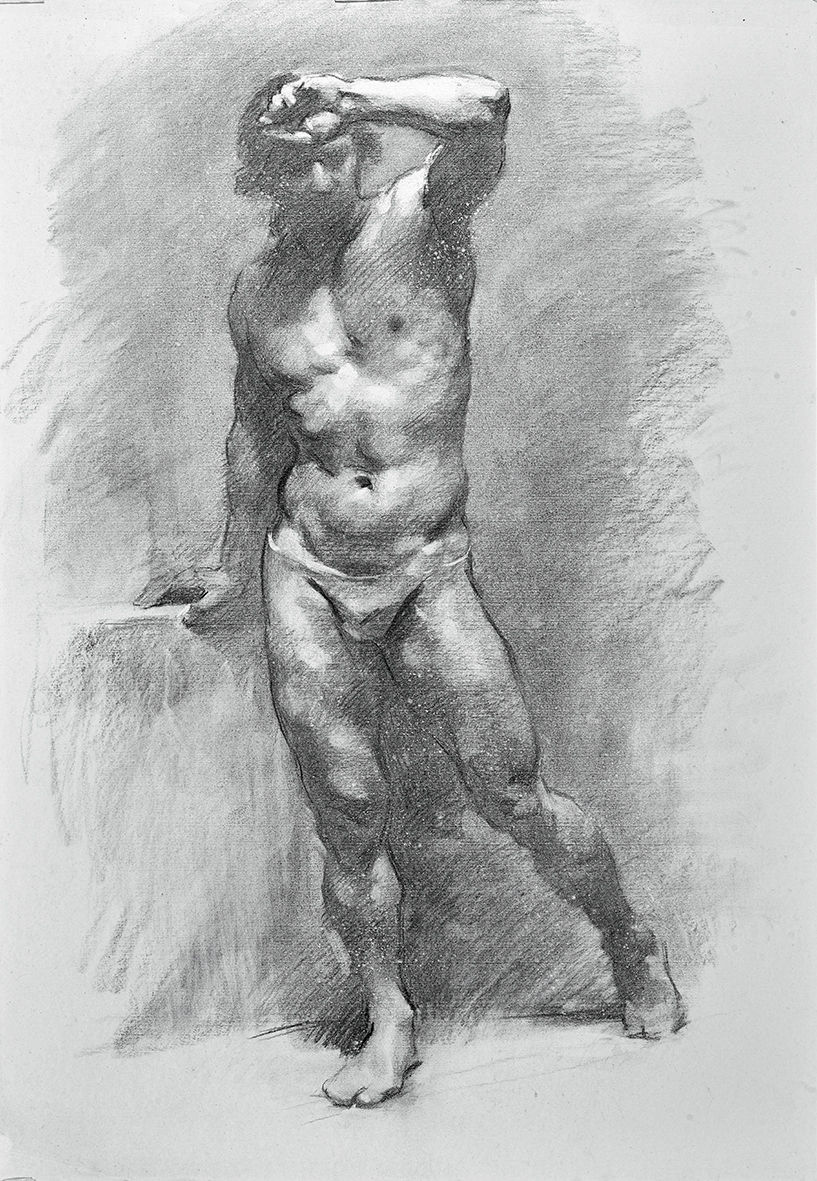
Following his return from West Germany, Tan taught at the Guangzhou Academy of Fine Arts for the next three decades while continuing a painterly practice grounded in observation, drawing, proportion, and sustained engagement with the motif. Across this period, he repeatedly returned to a relatively consistent repertoire of subjects, including familiar sitters, still-life objects, and local landscapes. Such continuity, however, did not correspond to stylistic immobility.
Tan’s painting changed considerably over time. His earlier work retained the weight and directness associated with the Sino-Soviet academic tradition in which he had been trained, including dense handling, emphatic modelling, and a strong construction of volume. Over subsequent decades, this approach became increasingly measured, with greater emphasis placed on proportion, compositional balance, and the organisation of pictorial space.
From the 2010s onward, a further shift became apparent. Paint surfaces grew thinner, brushwork more open, and atmospheric space increasingly important. In works produced after 2020, colour and light assumed a more pronounced role, while the boundaries between figures, objects, and their surroundings became less firmly defined. These developments did not entail an abandonment of Tan’s earlier training. Rather, they show how principles embedded within that formation could accommodate substantial changes in pictorial language.
What remained consistent was therefore not a particular style, facture, or compositional formula, but a method of sustained observation. Tan’s repeated return to familiar motifs makes this distinction especially visible. Relatively stable subjects provide a basis against which changes in handling, colour, spatial construction, and perception can be traced over time. Continuity here functions not as the opposite of change, but as the condition through which change becomes visible.
Seen in this way, Tan’s practice complicates any simple opposition between persistence and transformation. The academic formation examined throughout this essay persisted neither as an unchanged historical style nor as a tradition eventually superseded by contemporary practice. Its continuity was maintained through internal transformation.


Tan’s paintings therefore occupy a particular art-historical position. They do not chronicle political events or translate historical rupture into explicit iconography. Their relation to history resides instead in the conditions under which this painterly formation was constituted, transmitted, displaced, and transformed. The historical significance of this continuity lies not in the preservation of a stable canon, but in the capacity of a practice to continue changing after the frameworks that once secured its authority and legibility have themselves shifted.
The significance of Tan’s trajectory lies neither in restoring academic painting to a lost historical centre nor in claiming contemporaneity on its behalf. His case instead points to a less synchronous model of artistic history. Artistic formations cross cultural, institutional, and geographical boundaries; they carry earlier histories into new contexts and acquire different meanings as the temporal structures around them change. Tan’s practice offers one case through which this uneven movement between historical systems—and the transformations produced within that movement—can be observed.

Comments